APEC "China Year"|Chief Executive Lee Ka-chiu, John Attends APEC Meetings in Shenzhen
On the shores of the South China Sea, waves of opportun…
APEC “China Year”|Bay Area Opportunities, Meeting the Opening Year of the 15th Five-Year Plan
Time:2026-11-25 Source:大灣區進出口商業總會
On the shores of the South China Sea, waves of opportunity surge across the Greater Bay Area. President Xi Jinping will attend the APEC 33rd Economic Leaders’ Meeting and related events.
In November 2025, in Gyeongju, the Republic of Korea, President Xi Jinping announced during the handover segment for the host of the APEC 32nd Economic Leaders’ Meeting that China would host the APEC 33rd Economic Leaders’ Meeting in Shenzhen, Guangdong Province, in November 2026.
2026 marks the arrival of “China’s Moment” for APEC cooperation; it is also the opening year of the 15th Five-Year Plan.
When APEC “China Year” coincides with the opening year of the 15th Five-Year Plan, there emerges a clearer interpretation of the vision — “continuing to offer new opportunities for the Asia-Pacific and the world through new achievements in Chinese modernization”.
What China endeavours to deliver is exactly what the Asia-Pacific hopes for; what China provides is precisely what the world needs.
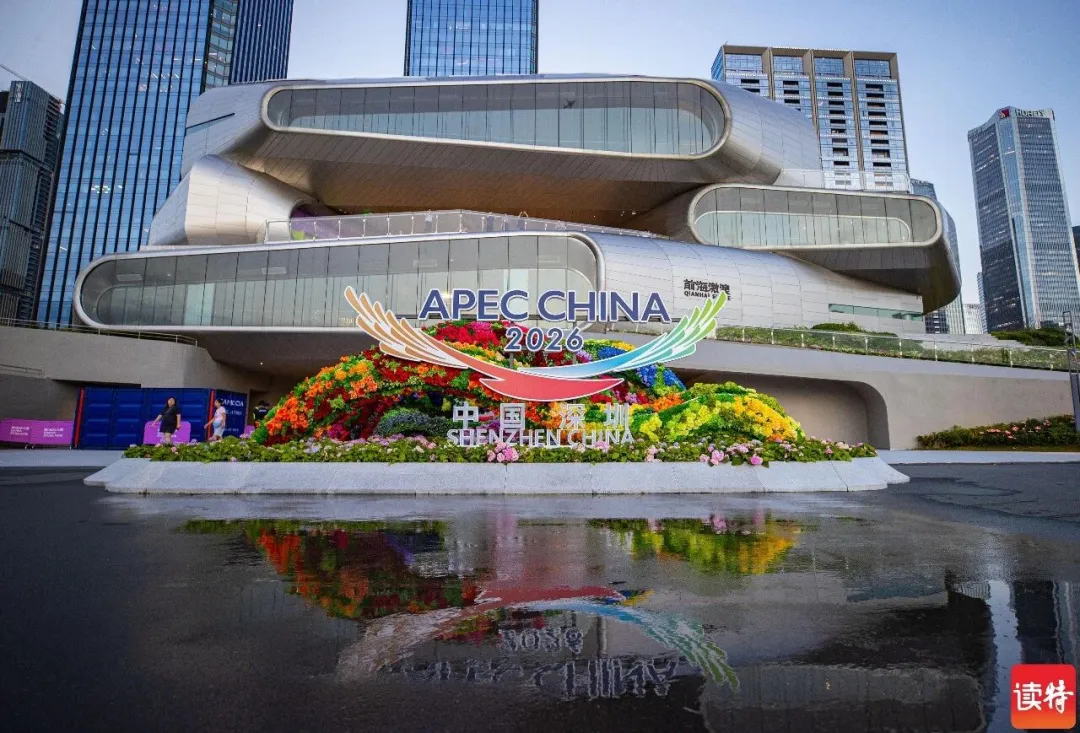
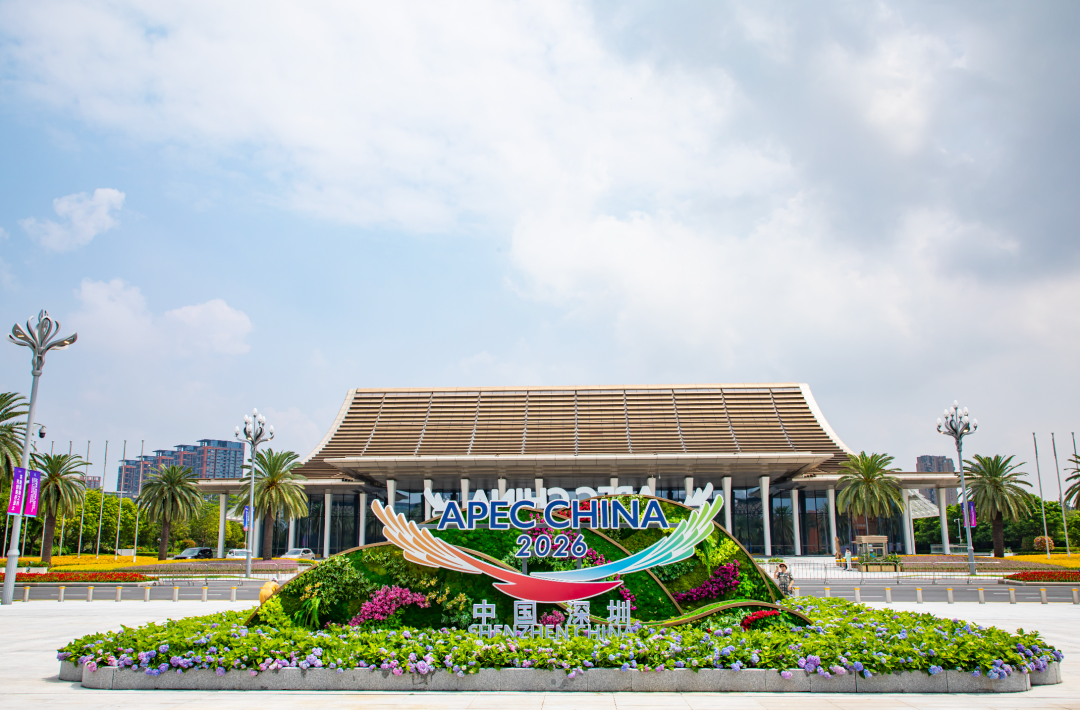
Decorations featuring the emblem of APEC “China Year” at Qianhai Stone Park in Shenzhen. (Shenzhen Special Zone Daily)
Openness is the mainstay of Asia-Pacific prosperity. Bringing APEC to Shenzhen represents a renewed commitment to the original aspiration of cooperation.
Shenzhen, China’s top city for foreign trade. Having grown from a small fishing village into a modern international metropolis, it serves as an important window to observe China’s strategy of pursuing mutually beneficial opening-up.
Founded to ride the tide of economic globalisation, APEC has led the Asia-Pacific to the forefront of global open development and written the “Asia-Pacific Miracle”.
After a 12-year interval, China once again takes on the role of APEC host.
In 2001, shortly before China’s accession to the World Trade Organization, the APEC Shanghai Meeting was successfully held, symbolising a fresh start for Asia-Pacific cooperation in the new century.
In 2014, China in a new era hosted the APEC Beijing Meeting, where all participants pledged to build a future-oriented Asia-Pacific partnership, outlining a vision for long-term regional development and shared prosperity.
Today, from establishing international cooperation platforms such as the Belt and Road Initiative to injecting new momentum into the global economy through the Global Development Initiative, China has become a leader and promoter of global openness.
Three terms as host bear witness to the historic process of China’s economic integration into the globe and its continuous advancement of reform and opening-up.
The Outline of the 15th Five-Year Plan highlights “expanding high-standard opening-up”. China’s door to the outside world opens wider and wider, bringing ever-upgraded opportunities for international cooperation.
At a time when forces driving and hindering economic globalisation are locked in contention, China’s hosting of APEC for the third time with support from all parties fully demonstrates the weight of an open China in the world. It further validates an important observation by President Xi Jinping: “By actively following the prevailing trends of global development, a country can not only grow stronger itself but also help steer these trends.”
The Outline of the 15th Five-Year Plan, a blueprint spanning 18 sections and 62 chapters, acts as a construction roadmap for China’s economic and social development over the next five years, as well as an opportunity list for the world.
“More development opportunities”, “a sound business environment”, “a broad platform for innovation” and “conditions for green growth” — the strengths and potential of China’s development vividly shared by President Xi Jinping with Asia-Pacific business leaders in Gyeongju, are clearly laid out in this Outline. Entrepreneurs remark that to seize new opportunities in China, one must understand the 15th Five-Year Plan.
Advancing self-reliance and strength in science and technology, fostering new-quality productive forces, developing a modern industrial system… As China forges ahead on its journey of Chinese modernisation, it brings to the Asia-Pacific not only tangible opportunities, but also the vision and philosophy to discover and create opportunities.
For the Asia-Pacific to achieve development and prosperity in the future, the key lies in jointly expanding the pie of cooperation.
Looking at the cooperation agenda for APEC “China Year”, artificial intelligence and the digital economy are prioritised. China’s proposals guide all parties to adapt to changes of the times and renew the “Asia-Pacific Miracle”.
The upcoming APEC CEO Summit in Shenzhen will be themed “Fostering Prosperity for Shared Future”. It will bring together political and business representatives to discuss topics including artificial intelligence and sustainable development. As more new consensus on cooperation converges in Shenzhen, the world will better grasp the meaning that “engaging with China means engaging with opportunities”.
The international landscape today is fraught with volatility and intertwined challenges, with unilateralism and protectionism on the rise, casting a shadow over global growth prospects.
The rougher the seas, the more we need to pull together. At the Gyeongju meeting, President Xi Jinping set the tone for APEC “China Year”: taking the opportunity of hosting the event, China stands ready to work with all parties to build an Asia-Pacific community.
The meeting theme “Building an Asia-Pacific Community for Common Prosperity” conveys a firm resolve to stay focused on goals and forge ahead. Since the launch of APEC “China Year”, all parties have actively taken part in relevant ministerial meetings and senior officials’ meetings. Over 300 conferences and events have been held successively in more than 10 Chinese cities, further consolidating consensus on building an Asia-Pacific community and putting in place its foundational framework.
The building of the Asia-Pacific community centres on people. From President Xi Jinping articulating the “Asia-Pacific Dream” in Beijing in 2014, calling for a more peaceful and affluent life for all people, to emphasising “putting people first” and “promoting common prosperity for all people in the Asia-Pacific” in Gyeongju, China’s proposals remain people-centred, committed to ensuring Asia-Pacific cooperation delivers better benefits for all people across the region.
Seeking self-improvement while benefiting others, and contributing to the wider world.
The period of the 15th Five-Year Plan is critical for laying a solid foundation and making all-round progress toward the basic realisation of socialist modernisation. Striving to basically achieve socialist modernisation within three five-year plan cycles from 2021 to 2035 embodies China’s global commitment: “When China manages its own affairs well, it is a contribution to the world.”
The Outline of the 15th Five-Year Plan aims to meet people’s ever-growing needs for a better life, while APEC “China Year” seeks to advance the wellbeing of Asia-Pacific people. The Pacific Ocean is vast enough to accommodate shared development for all. A modernising China is willing to share the dividends of development across mountains and seas to benefit more people.
Looking out from Shenzhen toward the expansive Pacific Ocean, this convergence of two important milestones is more than a historic summit. It reflects China’s vision and commitment to bringing stability and positive energy to the world through the certainty of its own development.
Source: Reposted from the WeChat official account of the Liaison Office of the Central People’s Government in the Hong Kong Special Administrative Region.
APEC "China Year"|Chief Executive Lee Ka-chiu, John Attends APEC Meetings in Shenzhen
On the shores of the South China Sea, waves of opportun…
On the shores of the South China Sea, waves of opportun…
 2025-12-30
 2025-11-21