
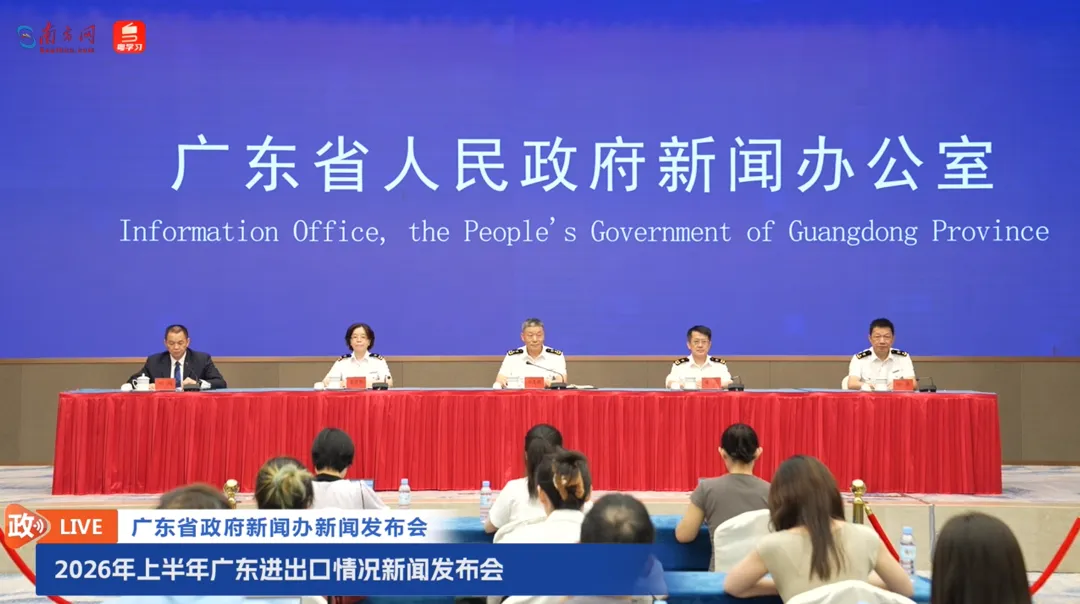
Press conference venue (Photo by Zhao Yifan) The State …
Industry news
Home > News
Industry News | SCIO Holds Series Press Conference “Off to a Strong Start for the 15th Five-Year Plan”
Time:2026-07-24 Source:大灣區進出口商業總會
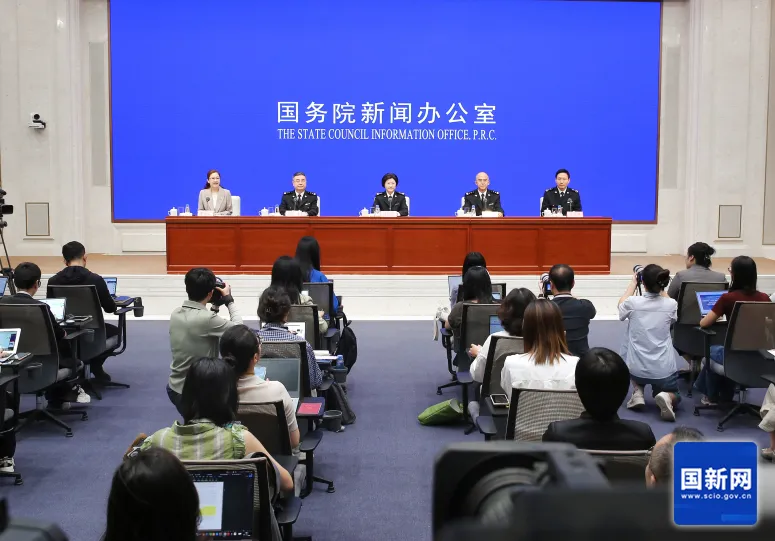
Press conference venue (Photo by Zhao Yifan)
The State Council Information Office (SCIO) hosted a themed press conference of the series Off to a Strong Start for the 15th Five-Year Plan on the morning of July 22. Sun Meijun, Minister of the General Administration of Customs of China (GACC); Wang Jun, Spokesperson and Vice Minister of GACC; Zhang Baofeng, Vice Minister of GACC; and Lü Daliang, Spokesperson of GACC and Director-General of the Department of Statistics and Analysis, briefed the media on efforts to implement the 15th Five-Year Plan, accelerate customs modernization and support the building of a powerful trading nation, and took questions from journalists.
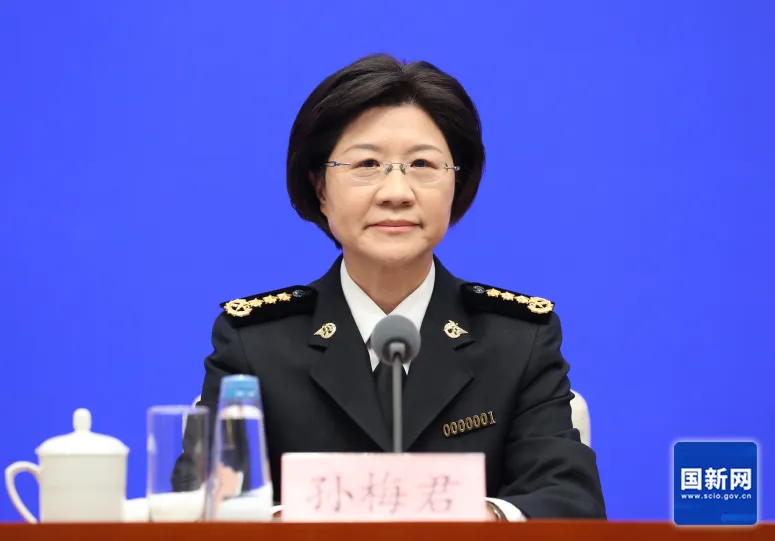
Sun Meijun (Photo by Xu Xiang)
Sun Meijun, Minister of the General Administration of Customs of China
Good morning, host, and dear friends from the media! First of all, thank you for your interest, attention and support for customs work. I am pleased to exchange views with you on implementing the 15th Five-Year Plan, advancing customs modernization and supporting the development of a powerful trading nation.
During the 14th Five-Year Plan period, under the strong leadership of the CPC Central Committee with Comrade Xi Jinping at its core, China made major strides in building a powerful trading nation. Over the past year in particular, amid a turbulent external environment, China’s foreign trade forged ahead against headwinds and maintained steady growth, demonstrating strong resilience and vitality. China remains the world’s largest trader in goods, with trade partners across the globe. Its customs clearance efficiency ranks among the world’s best, and the security shield at national borders has become stronger, providing solid support for high-quality development and high-standard opening-up.
This year marks the kickoff of the 15th Five-Year Plan. In the first half of the year, China’s imports and exports rose by 16.9% year-on-year, exports increased by 13.4%, and imports grew by 22.1%. We have witnessed development featuring improved volume and quality, greater innovation, green transition, smart upgrading, optimized imports and exports, and an expanding network of trade partners. It can be said that we have got off to a vigorous and promising start. Meanwhile, we are fully aware that the international landscape is volatile and fraught with uncertainties. Unilateralism and protectionism are on the rise, tariff and non-tariff barriers have multiplied, global economic and trade order as well as industrial and supply chains have suffered severe impacts, bringing markedly greater uncertainties to foreign trade.
We will earnestly implement the important requirement of coordinating domestic and international imperatives and balancing development and security, deliver on the strategic arrangements outlined in the Outline of the 15th Five-Year Plan, and fully implement the 15th Five-Year Plan for Customs Development and the 15th Five-Year Plan for Port Modernization. During the 15th Five-Year Plan period, we will strive to achieve systematic risk prevention and control, intelligent regulation, facilitated cross-border trade, and institutionalized collaborative governance. We will systematically upgrade customs modernization to usher in a new landscape featuring better regulation, higher security, greater facilitation and tougher anti-smuggling efforts, safeguarding high-quality development and high-standard opening-up. To attain these goals, we will focus on the following priorities:
First, serve high-quality foreign trade development with enhanced regulation.
Over the next five years, we will pursue dual driving forces of institutional innovation and technological empowerment to achieve both expedited clearance and effective regulation, focusing on three directions.
First, optimize regulatory systems. To foster new productive forces and cultivate new forms, models and growth drivers of foreign trade, we will push forward revisions to laws and regulations including the Customs Law, the Law on the Entry and Exit Animal and Plant Quarantine, and the Regulations on Rules of Origin. We will implement risk-based classified management to build one of the world’s most competitive customs regulatory systems.
Second, boost regulatory efficiency. We will roll out embedded concurrent regulation, integrating customs regulatory requirements into the industrial and supply chains of import and export enterprises. We will expand the coverage of the single-document multi-modal transport clearance model, linking the unified domestic market internally and unblocking global logistics corridors externally to help enterprises cut costs and raise efficiency.
Third, build smarter regulatory models. We will accelerate the iterative upgrading of Smart Customs. By 2030, over 90% of ports will be equipped with intelligent inspection equipment. The integration of artificial intelligence, big data and intelligent equipment will widely empower customs operations, enabling regulation and services that are omnipresent yet non-intrusive, making seamless clearance for enterprises and the public a normal practice.
Second, safeguard national borders and protect people with enhanced security standards.
We will fully implement the holistic approach to national security, bolster the new development pattern with a new security pattern, and effectively prevent and defuse all types of security risks.
First, comprehensive risk prevention. We will coordinate traditional and non-traditional security, as well as imports and exports, to effectively guard against risks related to politics, economy, biology, ecology, quality of import and export goods, and export-controlled items, preventing risks from interconnecting, evolving and spreading.
Second, risk prevention at the source. We will strengthen capacity to perceive emerging security risks to realize early detection, early warning and early response. Customs declaration marks the first link of clearance. We will guide enterprises to enhance compliance awareness, maintaining a declaration compliance rate above 95% to contain risks at the source.
Third, systematic risk prevention. We will establish a comprehensive risk management system covering all sectors, full chains, integrated factors and full-cycle governance, strengthen penetrating oversight over industrial and supply chains, and further upgrade border security capacity.
Third, advance open cooperation and win-win outcomes through greater facilitation.
Open cooperation and mutual benefit represent an inevitable requirement of Chinese modernization. Customs stands at the hub connecting domestic and international circulations. Over the next five years, we will continue special campaigns to facilitate cross-border trade, expand markets through opening-up and promote win-win results via cooperation, focusing on three improvements.
First, raise overall port clearance efficiency. We will advance both physical connectivity by optimizing port layout and upgrading infrastructure, and institutional connectivity to foster a world-class market-oriented, law-based and international business environment at ports, enabling smooth flow of goods and convenient travel for people.
Second, elevate the development level of opening-up platforms. Centered on high-standard development of Hainan Free Trade Port, we will build customs-supervised special zones with international competitiveness and influence. We will support comprehensive bonded zones in expanding capacity and improving quality, strengthening linkages between domestic and international markets and resources.
Third, upgrade the quality of trade cooperation. We will further implement the Smart Customs Partnership Programme, deepen international cooperation on import and export product standards, customs procedures, inspection and quarantine, and mutual recognition of enterprises. We will explore new space for digital trade, green trade and cross-border e-commerce to boost innovative foreign trade development.
Fourth, uphold a sound legal environment with tougher anti-smuggling efforts.
We will maintain constant pressure against smuggling to safeguard national security and development interests.
First, raise overall anti-smuggling capacity. In view of the professional and covert nature of smuggling activities, we will strengthen coordination between source prevention, port supervision and anti-smuggling investigations to leave no hiding place for lawbreakers. We will deepen comprehensive anti-smuggling governance to pool forces for full-range oversight and collaborative regulation. Focusing on tax security, controlled items, the building of a Safe China and Beautiful China, we will continue to launch the National Border Sword series of special operations.
Second, strengthen cross-border joint law enforcement. We will enhance information sharing and law enforcement cooperation with key countries, regions and international organizations, severely crack down on cross-border smuggling of drugs, solid waste and endangered flora and fauna. We will continue to launch Operation Mekong Dragon and Operation Gaia, contributing China’s share to global security governance.
I will stop here for my opening remarks. Next, my colleagues and I will take your questions. Thank you!
Q&A Session
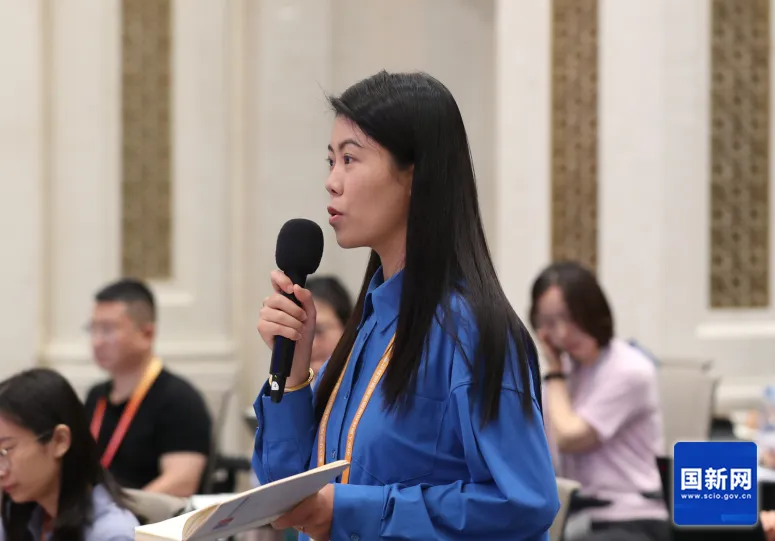
Reporter from National Business Daily (Photo by Zhao Yifan)
Reporter:
From “cherry affordability” to “durian affordability”, a growing variety of global goods have entered the Chinese market and become consumer favorites. What concrete measures will GACC take to boost consumption expansion? Thank you.
Sun Meijun:
Thank you for your question. I will invite Wang Jun to answer this.
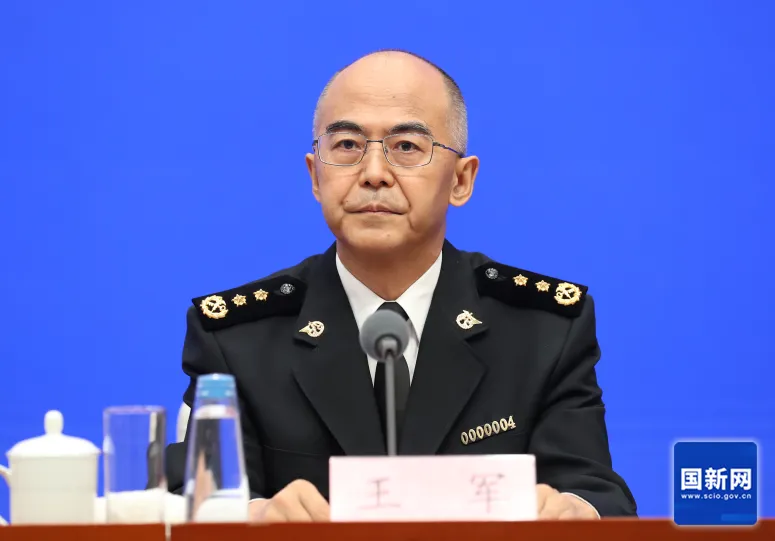
Wang Jun (Photo by Xu Xiang)
Wang Jun, Spokesperson and Vice Minister of the General Administration of Customs of China
As the journalist just mentioned, from “cherry affordability” to “durian affordability”, more global goods are reaching ordinary households. This vividly demonstrates China’s continued opening-up and willingness to share development opportunities with the world, as well as our efforts to expand imports and meet people’s demand for a higher quality of life.
As the authority responsible for entry and exit supervision, customs plays a vital role in implementing national strategies to expand domestic demand and boost consumption. Take durian as an example. Since 2022, we have completed market access for durian imports from five countries including Vietnam, Malaysia and Laos, continuously diversifying supply sources. Last year, China imported 1.868 million tonnes of durian, doubling the volume recorded in 2022. Durian is now widely available in fruit shops nationwide with more choices and lower prices.
China has become a major trading partner for more than 160 countries and regions worldwide, with broader sources, richer categories and better-structured imported goods. Milk from Oceania, coffee from Africa, chilled fresh salmon from Europe travel across oceans to enter Chinese consumers’ shopping carts.
During the 15th Five-Year Plan period, we will focus on three priorities in expanding imports to better satisfy consumer demand:
First, optimize market access. We will keep innovating regulatory models. Since the start of this year, we have granted market access to 264 varieties of agricultural and food products from 79 new countries. Sources of imported agricultural and food products now cover over 150 countries and regions globally. On the premise of ensuring safety, we will continuously streamline quarantine access procedures for agricultural and food imports and diversify import markets.
Second, optimize regulation. We will improve clearance procedures to cut cross-border logistics costs, ensuring fresh agricultural and food products reach consumers at affordable prices while maintaining quality. We will fully implement tariff concessions under free trade agreements, steadily expand the scope of recognized test results issued by third-party institutions, facilitating fast and optimized imports of consumer goods. We will strengthen monitoring and early warning on quality safety risks of imported goods, deepen cross-departmental regulatory coordination, intercept defective products accurately, and strictly uphold quality safety standards.
Third, optimize services. We will strongly support the first-launch economy by adjusting inspection requirements for imported consumer goods such as cosmetics to achieve synchronized global product launches. We will boost the exhibition economy by optimizing regulation enabling imported exhibits to be sold directly at large-scale exhibitions. To facilitate inbound consumption, we will simplify the tax refund procedures for overseas visitors. Starting July 1, the full verification model has been replaced by proportional random checks for refund applications below 10,000 yuan, and fully paperless processing has been rolled out. Through continuous regulatory improvements, we will enhance inbound consumption experience and polish the brand of Shopping in China.
We believe that as domestic economy continues to recover and consumption potential is unleashed, consumers will have access to more premium goods from around the world, and all countries can reap market dividends from China’s expanded imports. Thank you!
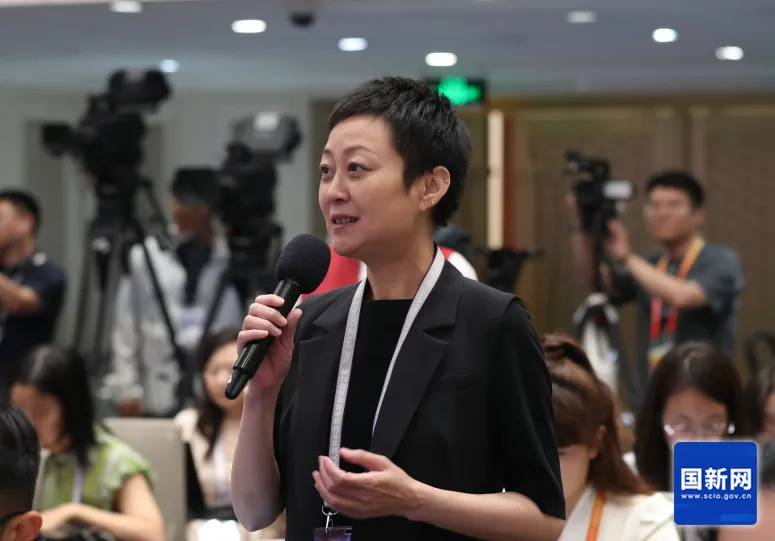
Reporter from China Media Group (Photo by Zhao Yifan)
Reporter:
Last week, also at this venue, GACC released data on China’s goods import and export in the first half of the year. The half-year foreign trade report card is impressive. Could you elaborate on relevant details? In addition, the Outline of the 15th Five-Year Plan proposes to accelerate the building of a powerful trading nation, improve the quality and efficiency of foreign trade, and promote balanced development of imports and exports. What measures will customs adopt to drive innovative, high-quality foreign trade development? Thank you.
Sun Meijun:
Thank you for your question. Last week, GACC released the H1 import and export data and responded to journalists’ concerns. Overall, China’s foreign trade got off to a vigorous start in H1, taking new steps in stabilizing volume and optimizing structure, laying a solid foundation for a good start to the 15th Five-Year Plan.
Various parties have analyzed the H1 foreign trade data. From my perspective, several prominent features stand out.
First, robust growth. China’s foreign trade saw moderate growth last year, and growth accelerated markedly in H1, with double-digit increases in total imports and exports, imports and exports. Growth stems from both expanded volume and improved quality. Imported goods cater to China’s development of new productive forces, industrial upgrading and consumption upgrading. Exported products precisely meet global demand with high quality, cost-effectiveness and strong competitiveness, winning favor among foreign enterprises and consumers. In particular, products related to artificial intelligence, green low-carbon development and high-end equipment enjoy strong market demand and favorable prices. Made-in-China products not only underpin stable global industrial and supply chains, but also inject precious certainty into an uncertain world.
Second, optimized structure. Driven by expanded domestic demand, import growth outpaced export growth by 8.7 percentage points. China is not merely the “world factory”, but also a “world market”. We pursue proactive opening-up and import expansion, and commercial authorities have launched a series of Export from China campaigns. In terms of market structure, emerging markets including ASEAN, Latin America and Africa continue to expand. China’s imports and exports with the United States rebounded from decline in April and maintained growth in May and June, showing that the new positioning of China-US relations has brought stable expectations for bilateral and global economic and trade development.
Third, improved quality. Momentum toward innovation, green transition and smart upgrading is strong. Exports of high-tech products rose by 39%, electric vehicles by 68.7%, and integrated circuits by 88.7%. Advanced intelligent and green low-carbon core technologies are becoming new hallmarks and golden business cards for Made-in-China exports.
Fourth, ample growth drivers. Enterprises actively adapt to changes. The number of companies engaged in import and export business increased by 115,000 in H1. Exports via cross-border e-commerce overseas warehouses surged 3.3 times. A total of 140 million Chinese consumers shop globally via cross-border e-commerce, and new forms and models of trade are thriving.
Against a backdrop of complex international dynamics and mounting trade barriers, China’s foreign trade demonstrates outstanding stability and growth potential. This is rooted in China’s complete industrial system, enormous market scale, strong scientific and technological innovation capacity, as well as the initiative of market entities. Guided by the Outline of the 15th Five-Year Plan, China’s economy is fully embarking on a path of high-quality development, generating strong internal impetus for innovative foreign trade growth.
During the 15th Five-Year Plan period, we will act on the decisions and arrangements of the CPC Central Committee and the State Council. Centered on building a powerful trading nation and improving the quality and efficiency of foreign trade, we will prioritize four areas of promotion within customs work.
First, foster stronger new drivers for foreign trade. The focus lies on optimizing regulation and enhancing services. We will improve regulatory systems for new forms of trade including cross-border e-commerce, market procurement trade and overseas warehouses, innovate regulatory approaches for AI products and green low-carbon transition products, and boost the development of producer services such as bonded logistics, bonded R&D, bonded maintenance and bonded testing.
Second, pursue diversified and shared markets. We will strengthen notification and comment on technical trade measures to help enterprises tackle trade barriers and go global smoothly. We will continue special campaigns to facilitate cross-border trade, fully implement free trade agreements including RCEP, promote cooperation through opening-up, break blockades via facilitation, and consolidate and expand diversified markets.
Third, advance balanced imports and exports. We will negotiate more trade cooperation documents, expand imports of advanced technical equipment, key components, energy resources and high-quality agricultural products from more sources. We will facilitate global goods entering China, enabling all countries to share opportunities in China’s vast market and offering diversified choices for Chinese consumers. The ongoing heated discussion over “durian affordability” serves as a typical example, as Deputy Minister Wang Jun just elaborated.
Fourth, smooth domestic and international dual circulation. We will build a regulatory system compatible with high-standard opening-up, create a transparent, stable and predictable institutional environment, innovate clearance models and optimize regulatory approaches to enable efficient and convenient cross-border flow of all production factors. China Customs operates 365 days a year with three shifts providing 24-hour services. We strive to deliver safe, convenient and efficient clearance services for enterprises and people worldwide. Thank you.
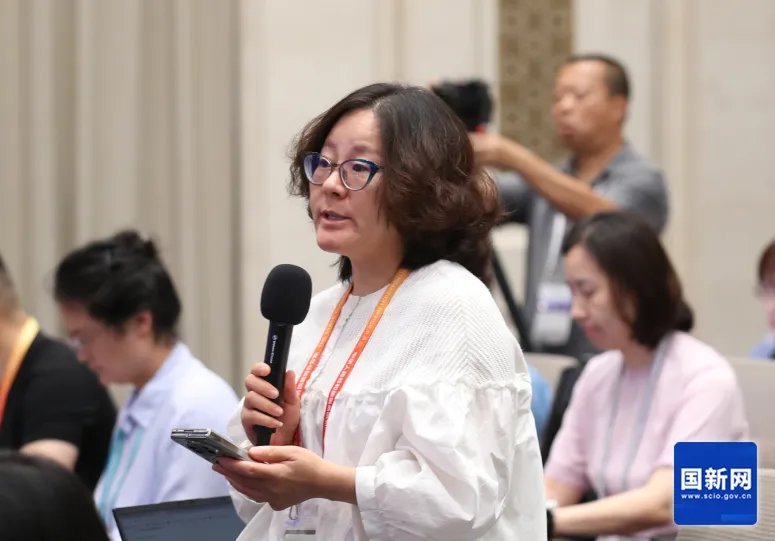
Reporter from Shandong Lightning News (Photo by Zhao Yifan)
Reporter:
In recent years, GACC has launched annual special campaigns to facilitate cross-border trade, helping enterprises cut costs and raise efficiency. What new expectations can we have for cross-border trade facilitation during the 15th Five-Year Plan period? What channels can enterprises use to resolve practical clearance difficulties? Thank you.
Sun Meijun:
Thank you for your question. I will invite Vice Minister Zhang Baofeng to answer this.
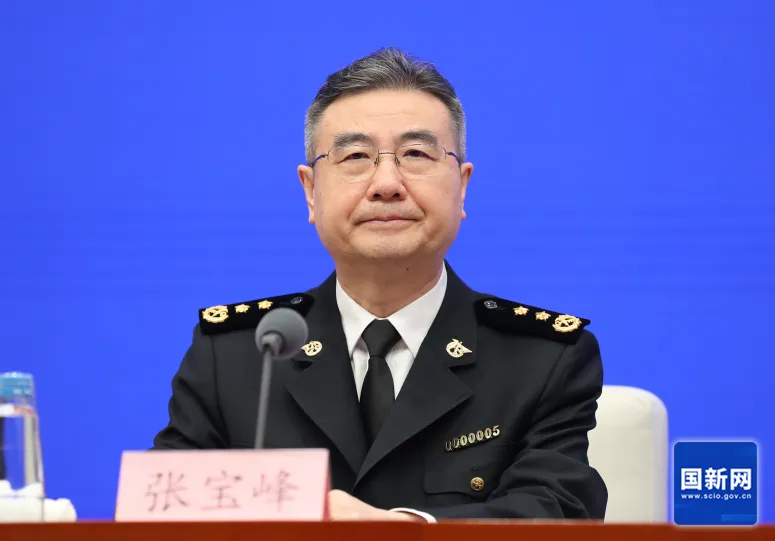
Zhang Baofeng (Photo by Xu Xiang)
Zhang Baofeng, Vice Minister of the General Administration of Customs of China
Thank you. As we all know, cross-border trade facilitation is an important way to optimize the port business environment and support innovative foreign trade development, and an inevitable requirement for expanding high-standard opening-up and unblocking domestic and international dual circulation. As the journalist mentioned, under the leadership of GACC during the 14th Five-Year Plan, we launched 108 innovative measures through special campaigns for cross-border trade facilitation, supporting simultaneous growth in foreign trade volume and quality. As Minister Sun just noted, one of our goals for the 15th Five-Year Plan is to realize cross-border trade facilitation. Therefore, we will advance this work in a more comprehensive and in-depth manner, promoting open cooperation and win-win outcomes through greater facilitation. We will deepen efforts in four key areas:
First, further improve the quality and effectiveness of facilitation. How? First, advance comprehensive work across the whole cross-border trade chain. We will push for information exchange, mutual recognition of documents and unified standards among different authorities along the trade chain. Second, expand coverage: extend participation in the facilitation campaign to all provinces nationwide, enabling policy dividends to benefit more enterprises and residents. Third, deliver targeted and effective measures to boost innovative foreign trade development and improve the business environment, helping import and export enterprises cut costs, explore markets and strengthen confidence.
Second, expand connectivity. We plan to advance three major initiatives. Many of you traveling to Hong Kong and Macao may have noticed that ports in Guangdong-Hong Kong and Guangdong-Macao areas have adopted new clearance models of One Port, Two Inspections and joint inspection, allowing inbound and outbound travelers to queue only once and greatly improving clearance experience. During the 15th Five-Year Plan period, we will roll out this model at more eligible border ports. This is the first initiative. Second, elevate the internationalization of the International Trade Single Window, pursue connectivity with more countries, and realize automatic exchange of electronic data including certificates of origin, inspection and quarantine certificates and mutual recognition information for high-credit enterprises. This will help enterprises access one-stop cross-border trade services covering clearance, logistics and finance. Third, promote joint development and shared utilization of smart ports with neighboring countries and regions. Notably, we will vigorously support intelligent cross-border transport such as automated guided vehicles to enable faster and smoother movement of import and export goods.
Third, accelerate clearance efficiency. Fast port clearance is the shared aspiration of enterprises and the direction of our work. We will widely promote embedded concurrent regulation and seamless clearance models integrated into production and logistics chains, facilitate information connectivity for sea, inland water and rail transport, and effectively help enterprises reduce costs. We have many successful cases. For instance, container transshipment time between sea and rail at many ports has been shortened to less than half an hour, cutting comprehensive transshipment costs by 20%. The quality safety inspection assessment process for exported lithium batteries, which once took 48 hours, now takes only 30 minutes. In addition, there are 75 Combined Port and One Port Link shipping routes in the Guangdong-Hong Kong-Macao Greater Bay Area, greatly lifting transshipment efficiency for import and export goods. Of course, we recognize there is always room for improvement in clearance efficiency. We will keep streamlining procedures and accelerating clearance to maintain international leading standards.
Fourth, strengthen targeted implementation of relevant policies. Guided by the goal of delivering benefits to the people, we will make trade facilitation measures better address the urgent difficulties of enterprises and residents, solicit public opinions and evaluate outcomes to ensure practical and effective policies. We will expand policy communication channels, regularly host customs-enterprise dialogue meetings and policy direct delivery sessions, and comprehensively upgrade the capacity of the 12360 Customs Hotline to handle complaints on demand. We strive to respond to every call and resolve every issue, ensuring more beneficial and relief policies reach enterprises and grassroots communities accurately. Thank you!
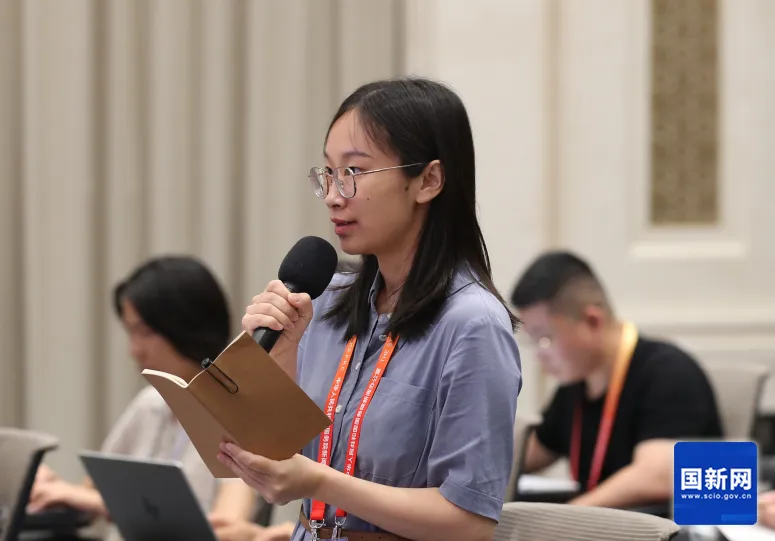
Reporter from China Securities Journal (Photo by Zhao Yifan)
Reporter:
During the 14th Five-Year Plan period, cross-border e-commerce developed rapidly in China and became a major growth engine for foreign trade. What plans does GACC have to support the development of cross-border e-commerce and other new trade forms and models during the 15th Five-Year Plan period? Thank you.
Sun Meijun:
Thank you for your question. I will invite Wang Jun to answer this.
Wang Jun:
In the complex and volatile international trade landscape, new forms and models represented by cross-border e-commerce, overseas warehouses and market procurement trade have demonstrated strong adaptability and risk resilience thanks to flexible and efficient supply chains, becoming robust support for China’s high-quality foreign trade development. During the 14th Five-Year Plan, GACC introduced a series of facilitation measures including full online clearance, electronic tax payment and cancellation of filing requirements for export overseas warehouses, enabling leapfrog growth of cross-border e-commerce. Innovative measures such as simplified declaration, elimination of paper documents and nationwide clearance based on declaration at procurement locations pushed market procurement exports to repeatedly set new records, contributing to the formation of the Yiwu Development Experience.
During the 15th Five-Year Plan period, we will continue to innovate regulation and optimize services, focusing on three priorities:
First, speed up clearance. Tailored regulatory schemes will be developed for new trade features: small individual orders, diverse goods and high frequency. For high-credit enterprises, we will implement simplified declaration with one-time filing valid for nationwide clearance. We will replicate and promote the reform of inspecting goods before loading for consolidated small commodity exports from Yiwu, resolving enterprises’ pain points of difficult cargo retrieval and reloading. We will optimize regulatory procedures for returned cross-border e-commerce goods and improve facilitation measures for returns from overseas warehouses, enabling faster clearance and barrier-free returns for e-commerce parcels, supporting enterprises to buy and sell globally.
Second, unblock logistics. We will support cross-border road transport for e-commerce exports under the model of one declaration, unified certificate and direct delivery. The multi-modal transport single-document clearance reform will be extended to market procurement trade, building a cross-border logistics network suited to small commodities, enabling end-to-end transport under one logistics document with lower costs and higher speed. We will promote functional integration of advance air cargo terminals and comprehensive bonded zones, moving the whole process of declaration, inspection, civil aviation security screening, warehousing and consolidation forward, enabling inland enterprises to enjoy airport clearance services locally.
Third, standardize management. Adapted to online cross-border transactions, we will advance collaborative governance between customs and enterprises, explore direct data connectivity between customs and e-commerce platforms, and deepen cooperation in risk early warning, advance interception and information sharing. We will strengthen supervision over the quality safety of import and export goods, urge enterprises to fulfill primary responsibilities, regularly conduct research on technical standards, policies and regulations of destination countries, provide targeted guidance for enterprises and improve their overseas compliance capacity. Thank you.
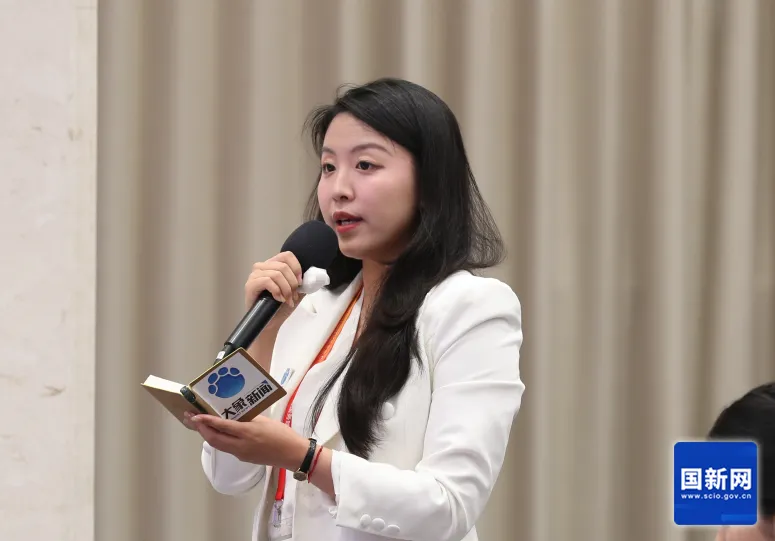
Reporter from Daxiang News (Photo by Zhao Yifan)
Reporter:
The Outline of the 15th Five-Year Plan emphasizes strengthening full-chain protection of intellectual property rights, and customs IP protection constitutes an important part. How will we further strengthen IP protection in entry and exit fields? Thank you.
Sun Meijun:
Thank you for your question. I will invite Lü Daliang to answer this.
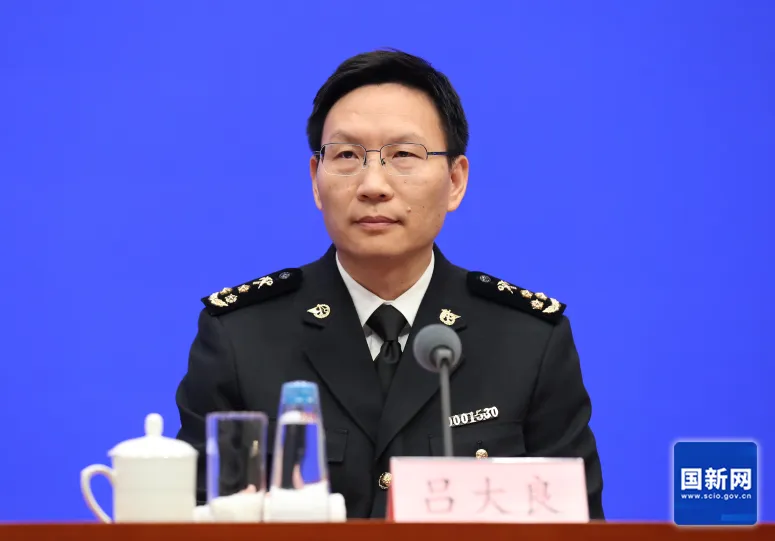
Lü Daliang (Photo by Xu Xiang)
Lü Daliang, Spokesperson of GACC and Director-General of the Department of Statistics and Analysis
Thank you for your attention to customs IP protection work. Intellectual property protection is a systematic project covering many areas and links. Customs protects IP rights related to entry and exit goods in accordance with law, preventing counterfeit and infringing goods from crossing national borders and entering the market. It ensures innovators in foreign trade reap due rewards and safeguards the legitimate rights and interests of Chinese and foreign enterprises and consumers. At present, nearly 60,000 IP right holders have filed records with customs, covering 134,000 items of various intellectual property rights, and the effectiveness of customs IP protection has become more prominent in three aspects.
First, protecting innovation. We provide targeted protection for high-tech enterprises, specialized, sophisticated, distinctive and innovative enterprises, and innovative firms to curb infringement and counterfeiting, safeguard corporate R&D investment, brand value and market space, and help translate more innovative achievements into new productive forces and international competitiveness.
Second, protecting enterprises’ legitimate rights and interests. We treat domestic and foreign right holders equally and provide equal legal protection for Chinese and foreign-funded enterprises. Last year, we launched the Special Campaign on Customs IP Protection to Stabilize Foreign Investment, established communication and rapid response mechanisms, protected brand reputation and investment rights of foreign-funded enterprises with practical actions, and demonstrated China’s firm resolve to build a market-oriented, law-based and international first-class business environment.
Third, protecting consumer rights, health and safety. Counterfeit products often have unknown sources, lack safety standards and unstable quality. Once entering the market, they disrupt market order and may endanger consumers’ health and property safety. Customs cracks down on infringement and counterfeiting in accordance with law, effectively preventing counterfeit goods from reaching consumers via cross-border channels.
During the 15th Five-Year Plan period, we will continue to strengthen customs IP protection in line with the strategy of full-chain protection, focusing on four tasks. First, push forward revisions to the Regulations on Customs Protection of Intellectual Property Rights to further improve top-level design. Second, optimize the review model for IP filings, targeting over 20% growth in filed records to benefit more innovators. Third, apply new technologies including big data and artificial intelligence in IP protection, conduct dynamic risk profiling for infringing risks of entry and exit goods to enable targeted enforcement. Fourth, launch continuous special law enforcement campaigns adapting to evolving trade patterns, strengthen cross-departmental law enforcement collaboration, and deeply participate in global IP governance.
China Customs will deliver stricter, impartial and efficient IP protection to drive infringers out of the market and reassure innovators, supporting innovative foreign trade development. Thank you.
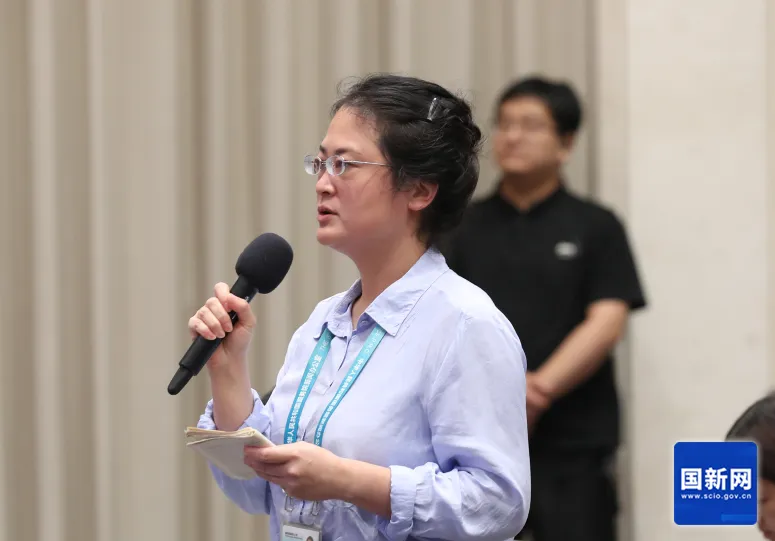
Reporter from Hong Kong Bauhinia Magazine (Photo by Zhao Yifan)
Reporter:
China has fully implemented zero-tariff treatment for 53 diplomatic African countries starting this May. As customs stands at the forefront of opening-up, how will we further promote open cooperation and win-win outcomes? Thank you.
Sun Meijun:
Thank you for your question. In February this year, President Xi Jinping announced the full implementation of zero tariffs for 53 African diplomatic countries effective May 1. This fully demonstrates China’s unwavering commitment to expanding opening-up and its sense of responsibility as a major country. The sound performance of China’s foreign trade in H1 once again proves that open cooperation is the right path while protectionism leads nowhere.
Customs serves both as a guardian of border security and a facilitator of high-quality development and high-standard opening-up. We will implement the decisions of the CPC Central Committee and the State Council and fully deliver on tasks outlined in the 15th Five-Year Plan Outline, focusing on the following work.
First, implement the customs closure operation of Hainan Free Trade Port at a high standard. Full-island customs closure of Hainan FTP represents a landmark measure for China to pursue high-standard opening-up. Since the official full-island closure on December 18 last year, facilitation measures for the first and second lines have operated smoothly, and policy dividends such as zero tariffs and offshore duty-free shopping continue to be unleashed. Enterprises directly benefit from lower costs and higher efficiency; consumers find imported goods more accessible and affordable; more tourists visit Hainan; and conditions for Hainan’s high-quality development have improved. During the 15th Five-Year Plan period, we will deepen reform and innovation to build a special zone featuring accessible facilitation and effective regulation, better supporting high-standard construction and high-quality development of Hainan Free Trade Port.
Second, elevate the innovative leading capacity of opening-up platforms. In April this year, the General Office of the State Council forwarded the Measures of GACC on Expanding Capacity and Improving Quality of Comprehensive Bonded Zones, which contains 24 initiatives. Together with relevant authorities, we will advance comprehensive transformation and upgrading of industrial forms, functions, development models and regulatory approaches of comprehensive bonded zones nationwide. We will leverage bonded policies, global production factors and market resources to lead innovative trade development and play a greater role in unblocking domestic and international dual circulation.
Third, ensure proactive and unilateral opening-up policies deliver tangible results. As you mentioned, China introduced zero tariffs for African diplomatic countries in May. We have formulated regulatory schemes for zero-tariff implementation, rolled out risk-based classified management, adopted facilitation measures including integrated access, and expanded green channels for agricultural and food exports to China. China’s imports and exports with Africa rose by 19.6% in H1. At present, zero tariffs apply to 63 countries. We will fully implement high-level economic and trade agreements, strengthen alignment of customs procedures, inspection and quarantine and rules of origin, and support expansion of high-standard free trade agreement networks.
Fourth, advance the Smart Customs Partnership Programme. We will leverage China’s early progress in building Smart Customs to better support high-quality Belt and Road cooperation. Priority will be given to accelerating the AI + Customs initiative, leading the digital transformation of global customs governance, building broader and more efficient connectivity platforms to realize information exchange, mutual recognition of regulation and mutual law enforcement assistance. We will further expand the circle of trade partners and share dividends brought by artificial intelligence with more countries, especially the Global South. Thank you.
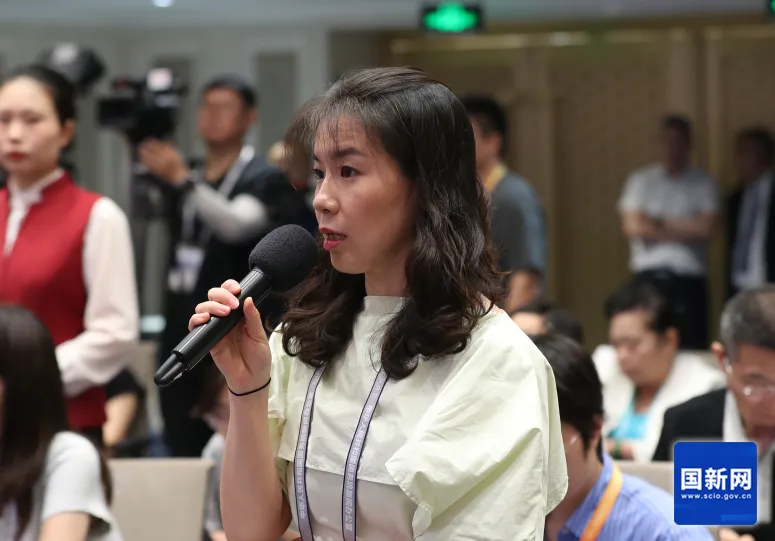
Reporter from Xinhua News Agency (Photo by Xu Xiang)
Reporter:
We have noticed that the 15th Five-Year Plan for Port Modernization has been released recently, explicitly stating that major progress will be achieved in port modernization by 2030. What key areas will customs prioritize to drive port development and construction? Thank you.
Sun Meijun:
Thank you for your question. I will invite Zhang Baofeng to answer this.
Zhang Baofeng:
First of all, thank you for your attention to port work. Approved by the State Council, GACC and the National Development and Reform Commission recently jointly issued the 15th Five-Year Plan for Port Modernization, which serves as the blueprint for national port work during the 15th Five-Year Plan period.
The CPC Central Committee and the State Council attach great importance to port work. During the 14th Five-Year Plan, port development pursued high-quality growth and effectively guaranteed smooth customs closure for major national opening-up platforms including Hainan Free Trade Port and the Guangdong-Macao In-depth Cooperation Zone in Hengqin. During the 15th Five-Year Plan period, we will target the goals of port modernization in the new era, develop five-type ports that are safe, efficient, smart, law-based and green, and strive to build world-class modern ports with Chinese characteristics. There is extensive work ahead, and I will focus on four priorities.
First, optimize port layout. Following the principles of clear positioning, complementary functions and dynamic adjustment, we will coordinate the layout of sea, land, air and rail ports, integrate them into the national comprehensive three-dimensional transport network, and jointly build a diversified and resilient international transport corridor system. We will accelerate key border port projects outlined in the national 15th Five-Year Plan, deliver 57 port facility upgrading projects in the national port 15th Five-Year Plan with high quality, speed up construction of the Turgart and Khorgos-Gants Mod railway ports, and boost China’s cross-border connectivity southward, westward and northward. For air ports, we will promote separate passenger and cargo operations and support dedicated air cargo ports to expand scale.
Second, achieve smarter port operation. Forty-three key ports will be included in the national Smart Port Construction Project for the 15th Five-Year Plan. We will expand and deepen scenarios applying AI technologies at ports, advance integrated development of smart ports, smart customs, smart border inspection and smart maritime administration. The outlook for smart ports is promising: modern unmanned terminals operate busily and orderly; at passenger inspection channels, inbound and outbound travelers can complete clearance smoothly guided by intelligent robots; land ports will realize autonomous driving, intelligent inspection and efficient passage.
Third, establish standardized port systems. Standardization forms a core pillar of port modernization. We have initiated the application for establishing the National Technical Committee for Port Standardization. It will coordinate resources to advance the development and improvement of port standard systems in a scientific and forward-looking manner. Through this common high-standard language, we will promote resource sharing and shared use of facilities and equipment among ports, forming a high-level modern port network ecosystem. I sincerely invite all sectors of society to continue paying attention to port development and participate in port standardization work.
Fourth, strengthen the radiating and driving role of ports. Ports serve both as channels for opening-up and key engines of economic development. In H1, the so-called port economy maintained positive momentum. For example, bonded bunkering at ports developed rapidly, with relevant businesses at Zhoushan Port ranking among the world’s top three. Border port tourism remains popular, effectively boosting local employment and infrastructure improvement. During the 15th Five-Year Plan period, we will help local governments leverage ports’ strength connecting domestic and overseas markets, coordinate with opening-up platforms such as comprehensive bonded zones, drive innovative development of manufacturing and port services, accelerate growth of trade, cultural tourism and logistics in border areas, and support border stability, development and prosperity for residents. Thank you!

Reporter from 21st Century Business Herald (Photo by Xu Xiang)
Reporter:
At all ports, customs officers are using intelligent equipment such as AI smart glasses and large CT scanners to assist operations, greatly lifting port clearance and risk management capacity. What steps will be taken to further advance Smart Customs construction and continuously improve overall port regulatory efficiency? Thank you.
Sun Meijun:
Thank you for your question. I will invite Wang Jun to answer this.
Wang Jun:
Thank you. In 2021, General Secretary Xi Jinping put forward the major initiative of Smart Customs, Smart Border, Smart Connectivity, charting the course for customs development in the new era. Over the past five years, we have systematically reshaped customs business processes with digital and intelligent technologies, and Smart Customs development has achieved overall assembly and taken initial shape. For instance, the well-known Mobile Clearance System for Inbound and Outbound Parcels integrates online declaration, tax payment, return shipment, tax rebate and progress inquiry, enabling people to complete customs formalities for cross-border parcels without leaving home. The AI smart glasses and large CT scanners you mentioned have been widely deployed at ports. In the recently popular TV drama Golden Customs, customs officers rely on years of experience to identify suspects at a distance. Now empowered by intelligent equipment, they can see more clearly and conduct more accurate inspections. These are tangible outcomes of Smart Customs development.
During the 15th Five-Year Plan period, we will deepen Smart Customs development focusing on three areas:
First, empower precise regulation via digital intelligence. Drawing on massive data and large AI models, we will build a smart brain for customs supervision. The system will automatically identify risks, issue early warnings and facilitate timely response, leaving no room for smuggling and illegal activities. Meanwhile, as Minister Sun mentioned, we will roll out embedded concurrent regulation, directly connecting customs supervision operations with enterprises’ production, warehousing and logistics systems. Enterprises no longer need to repeatedly submit paper documents or suspend production for inspections, achieving more accurate regulation, higher efficiency and better business environment.
Second, upgrade intelligent equipment for smoother clearance. More high-tech regulatory equipment will be deployed, including intelligent scanning devices, handheld terminals and inspection robots for rapid container screening. This will drastically reduce manual on-site unpacking and cargo handling, minimizing cargo dwell time at ports. We will fully advance the reform of direct release upon intelligent image review for high-credit enterprises. Combining non-intrusive scanning and intelligent image analysis, goods under inspection can be verified rapidly and released without unpacking once risks are ruled out. Intelligent regulation will be accelerated to enable express clearance for cargo.
Third, optimize operational processes for more considerate services. For passenger clearance, we will integrate temperature monitoring, radiation detection and baggage supervision, and link backend intelligent analysis with on-site law enforcement. Checked baggage at air ports will complete machine inspection before collection. While intercepting risks precisely, legitimate inbound and outbound travelers can enjoy seamless clearance. For enterprise services, we will continuously upgrade the one-stop customs service platform. Similar to intelligent navigation, it will push targeted policy support matching each market entity’s situation, shifting from enterprises seeking policies to policies reaching enterprises, delivering tailored personalized services. Thank you.
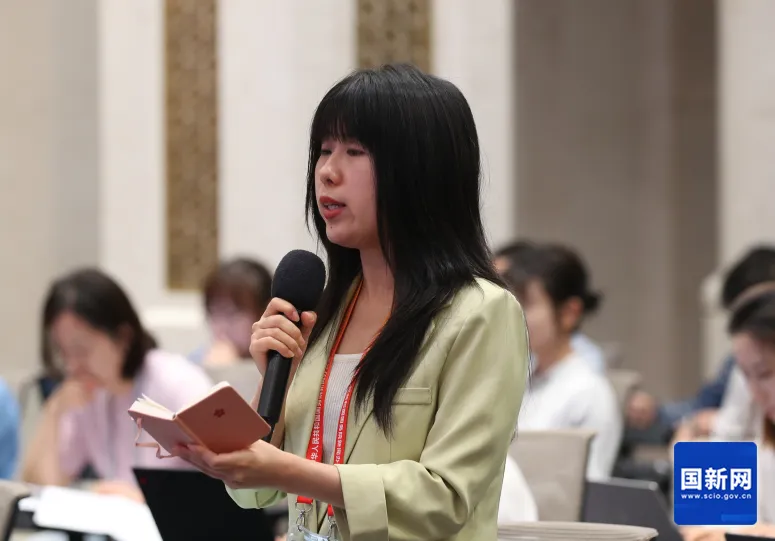
Reporter from Dazhong News & Dazhong Daily (Photo by Xu Xiang)
Reporter:
International transport corridors including China-Europe Railway Express and the New International Land-Sea Trade Corridor not only boost China’s foreign trade but also benefit residents along the routes. How will customs play its role in developing a diversified and resilient international transport corridor system? Thank you.
Sun Meijun:
Thank you for your question. I will invite Lü Daliang to answer this.
Lü Daliang:
International economic and trade operations rely heavily on international logistics support, and international transport corridors serve as transnational arteries for logistics. As you noted, corridors such as the China-Europe Railway Express and the New International Land-Sea Trade Corridor connect rivers and seas, link inland and overseas markets, and play an increasingly prominent role in expanding high-standard opening-up, strengthening industrial and supply chain resilience, and unblocking domestic and international dual circulation.
The development of international transport corridors requires customs participation, and their efficient operation relies on customs support. During the 15th Five-Year Plan period, customs will leverage its functions to foster a diversified and resilient international transport corridor system, focusing on three directions.
First, advance infrastructure connectivity. As Vice Minister Zhang Baofeng explained, we will optimize port layout aligned with opening-up strategies and transport systems, accelerate construction of key hub and regional node ports, upgrade capacity of major border ports, develop more smart ports, and maximize ports’ role as gateways for opening-up. Meanwhile, we will improve customs regulatory services to support China-Europe and China-Central Asia Railway Express services, back the construction of cargo assembly hubs and node cities, and guarantee diversified and unobstructed cross-border logistics corridors.
Second, promote integrated logistics models. We will adjust customs regulatory models to match logistics innovations, develop clearance supervision for multi-modal transport of import and export goods, and accelerate cross-border logistics while pursuing green low-carbon development. As Minister Sun mentioned in her opening remarks, we aim to raise the coverage of the multi-modal transport single-document clearance model to over 50% over the next five years. We will also advance the parallel port logistics model in Hainan and Guangdong, support same-vessel transport for domestic and foreign trade, end-to-end single-document multi-modal transport, and multi-directional feeder shipping between ports, boosting coordinated development of Hainan Free Trade Port and the Guangdong-Hong Kong-Macao Greater Bay Area.
Third, deepen cross-border regulatory cooperation. International transport corridors connect domestic and overseas territories. Smooth operation requires coordination between domestic and overseas port law enforcement authorities. Even differences in working hours — for instance, customs offices closing overseas while clearance is still underway domestically — will hinder movement of goods and people. We will deepen port and clearance cooperation with neighboring countries, pursue joint development and shared benefits for cross-border transport corridors, jointly advance Smart Customs, Smart Border and Smart Connectivity, and support open development and modernization of all participating countries. Thank you!
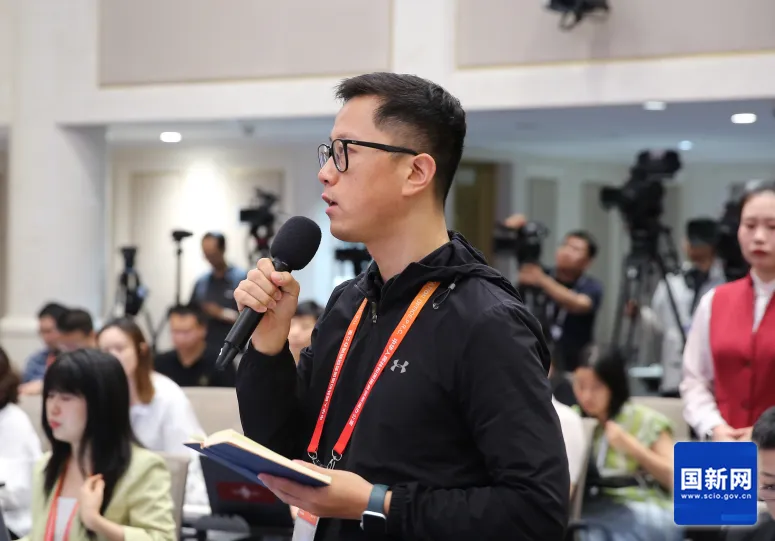
Reporter from Cover News (Photo by Xu Xiang)
Reporter:
Security underpins development. As guardians of national borders, what concrete arrangements will customs make to safeguard border security and combat smuggling during the 15th Five-Year Plan period? Thank you.
Sun Meijun:
Thank you for your question, and thanks for your attention to anti-smuggling work. Border security constitutes a vital component of national security. China has the world’s largest trade volume, and customs serves the largest number of regulated entities globally. Let me share a set of figures to illustrate the scale: on average every day, 400,000 containers, 15 million tonnes of goods, 22 million parcels and 2 million people pass through ports nationwide.
Port frontlines stand at the intersection of domestic and international dual circulation, hubs for flows of people, goods and capital, and convergence points of various security risks. As China opens wider to the world, customs faces increasingly arduous tasks to safeguard border security. The Outline of the 15th Five-Year Plan calls for safeguarding the new development pattern with a new security pattern. We will pursue systematic risk prevention and intelligent regulation, adopt a comprehensive set of prevention, control and enforcement tools, strengthen customs anti-smuggling investigations and comprehensive anti-smuggling governance, and firmly hold the first line of defense for border security.
First, strengthen port inspection to safeguard national security and development interests. We will prioritize.
News
GBAIEA
 2025-12-30
 2025-11-21
11月20日,大湾区进出口商业总会联合华润创业建设投资有限公司主办,广东省商务厅驻香港经济贸易代表处协办,广东…